15 Marmaris Travel Tips Every First-Time Visitor Should Know

 React
Every summer I watch the same small mistakes repeat themselves. A couple pays twice what they should for a taxi because nobody switched on the meter. A family books a “relaxing” boat trip and spends seven hours next to a speaker playing dance music. Someone hands over a card at a seafront restaurant and gets charged in pounds at a terrible rate.
None of this ruins a holiday, but it all adds up. After nine years of living here, these are the fifteen things I tell friends before they arrive. If you are still planning the bigger picture (when to come, where to stay, what to see), start with the Marmaris Travel Guide and come back here for the practical details.
Money
1. Pay in lira, and say no to “your home currency”
Cards are accepted almost everywhere: hotels, restaurants, supermarkets, most bars and many shops in the bazaar. When the card machine asks whether you want to pay in lira or in pounds, euros or dollars, always choose lira (TL). Paying in your home currency lets the shop’s bank set the exchange rate, and it is almost always worse than your own bank’s.
The same goes for prices written in euros or pounds on menus and in shops. They are usually rounded in the seller’s favour. Ask for the lira price.
2. Exchange money in town, not at the airport
If you want cash, the exchange offices (döviz bürosu) in the town centre generally offer far better rates than the airport or your hotel reception. Compare two or three; the rate is displayed on a board outside. ATMs are everywhere, but many charge a withdrawal fee on top of whatever your own bank charges, so take out larger amounts less often instead of small amounts every day.
Keep some cash anyway. Dolmuş drivers, small kiosks, street food stalls and some taxis prefer it.
3. Know the tipping customs
Tipping is appreciated but not complicated:
- Restaurants: around 5-10% if service is not already included. Check the bill for “servis”.
- Bars and cafés: rounding up or leaving small change is fine.
- Taxis: round up to the nearest convenient figure.
- Boat trips: there is often a tip box for the crew at the end of the day; give what you feel the day was worth.
- Hotels: a small amount for housekeeping at the end of your stay is a kind gesture.
4. Ask the price before you order
Most restaurants and bars are honest, but prices are not always visible, especially for cocktails, shots and fish sold by weight. A simple question before ordering avoids any argument at the end. In a fish restaurant, ask for the price per kilo and how much the fish you chose weighs before it goes on the grill.
Getting around
5. Use the city buses and dolmuş
The cheapest way to move between the centre, Uzunyalı, İçmeler and Armutalan is the municipal bus or dolmuş. On these routes, the 2026 fare is 42 TL (about $0.85) per adult when you board with an electronic card. You pay with a Muğla Kart travel card; ask at a kiosk near the bus stops where to buy and top one up.
Buses run frequently along the seafront during the day in summer. They are less frequent late at night, so check the last departure if you are staying outside the centre.
6. Make sure the taxi meter is running
Taxis are easy to find at ranks along the seafront and in the centre. Licensed taxis are yellow and have a meter; make sure it is switched on before you set off, or agree the fare in advance. As a guide, a taxi from İçmeler to the centre costs about 400-500 TL ($8-10), and from Armutalan or Siteler about 250-350 TL ($5-7).
7. Plan your airport transfer before you land
Dalaman Airport is about 1.5 hours away. The Havaş bus costs 420 TL (about $8.50) but takes you to the bus station, not your hotel, and its departures are timed around domestic arrivals. If you land late on an international flight, book a private airport transfer or plan on a taxi (around 3,500 TL / $71 per car). Full details are in the guide on how to get to Marmaris.
Avoiding tourist traps
8. Ask exactly what a boat trip includes
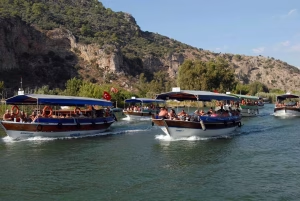
“Boat trip” can mean very different things. Most full-day trips cost around 1,000-1,500 TL ($20-30) per person and include lunch and hotel pick-up, but drinks are usually extra. Before you pay, ask:
- Which bays does it visit, and how long is the trip?
- Is lunch included? Are drinks extra?
- How many passengers does the boat carry?
- Is there loud music all day? (Party boats and family boats are very different.)
- What happens if the trip is cancelled because of the weather?
If you are travelling with young children or anyone with limited mobility, also ask about boarding steps, shade and toilets.
9. Treat promoters and “free” drinks with care
On Bar Street and along the seafront, promoters will offer free shots, two-for-one deals or free entry. These can be genuine, but ask exactly what is included and what the next drink costs. Never leave a drink unattended. For the full picture on clubs, prices and closing times, see the Marmaris nightlife guide.
10. Haggle in the bazaar, not in the supermarket
In the Grand Bazaar and in souvenir shops, prices are often open to negotiation. Be friendly, take your time and walk away if the price does not feel right; you will often be called back. In supermarkets, pharmacies and shops with printed price tags, prices are fixed. For ideas on what is worth bringing home, read what to buy in Marmaris.
11. Check what the sunbed charge covers
Public beaches are free to walk on, but sunbeds and umbrellas are not. At beach clubs, a sunbed with entry typically costs 500-800 TL ($10-16) on weekdays and 800-1,200 TL ($16-24) at weekends. Some venues count part of the fee towards food and drinks; others do not. Ask before you lie down, not when the attendant arrives with the bill.
Health, heat and comfort
12. Drink bottled water
Tap water is treated and fine for brushing your teeth, but most locals, me included, drink bottled water. It is sold everywhere and is inexpensive in supermarkets; large bottles are much cheaper than small ones bought from beach kiosks.
13. Take the summer sun seriously
In July and August, afternoon temperatures regularly reach the mid-30s Celsius, and it feels hotter on open boats, beaches and stone streets. I plan walking and sightseeing for the morning or late afternoon, wear a hat, use high-factor sunscreen and always carry water. On the beach, follow the flags and lifeguard advice and keep an eye on children near the water.
If you feel dizzy, sick or confused from the heat, stop, move to the shade and drink water. In an emergency, call 112. For minor problems, a pharmacy (eczane) is the first stop; pharmacists are very helpful, and many speak some English. A sign on every closed pharmacy shows the nearest one on night duty (nöbetçi eczane).
14. Respect fire warnings in the forests
The pine forests around the bay are beautiful and, in summer, very dry. During high-risk periods, forest roads and picnic areas may be closed. Respect any closures, never light a fire or barbecue in wooded areas, do not throw cigarette ends from the car window, and take your rubbish with you.
Culture and etiquette
15. Dress respectfully away from the beach, and learn a few words
Swimwear is fine on the beach and at the pool, but cover up when walking through town, going into shops or sitting in a restaurant. If you visit a mosque, shoulders and knees should be covered, women should bring a scarf to cover their hair, and shoes come off at the entrance. Avoid visiting during prayer times, especially at Friday midday prayers.
A few words of Turkish go a long way, and people genuinely appreciate the effort:
| English | Turkish | Pronunciation |
|---|---|---|
| Hello | Merhaba | mer-ha-ba |
| Thank you | Teşekkür ederim | teh-shek-kür eh-deh-rim |
| Please | Lütfen | lüt-fen |
| How much? | Ne kadar? | neh ka-dar |
| The bill, please | Hesap, lütfen | heh-sap lüt-fen |
| Water | Su | soo |
| Yes / No | Evet / Hayır | eh-vet / hai-ur |
You will also notice images of Atatürk, the founder of the Turkish Republic, in shops, offices and on the seafront statue. He is deeply respected here, so it is best to avoid jokes or careless remarks about him. The story behind the seafront monument is in our guide to the Atatürk Statue in Marmaris.
2026 prices mentioned in this guide
| Item | 2026 price | Approx. USD |
|---|---|---|
| City bus, centre to İçmeler or Armutalan (electronic card) | 42 TL | ~$0.85 |
| Taxi, İçmeler to centre | 400-500 TL | $8-10 |
| Taxi, Armutalan or Siteler to centre | 250-350 TL | $5-7 |
| Havaş bus, Dalaman Airport to Marmaris | 420 TL | ~$8.50 |
| Taxi, Dalaman Airport to Marmaris | ~3,500 TL per car | ~$71 |
| Full-day boat trip | 1,000-1,500 TL | $20-30 |
| Beach club sunbed and entry, weekdays | 500-800 TL | $10-16 |
| Beach club sunbed and entry, weekends | 800-1,200 TL | $16-24 |
Final thought: leave room in your plans
The holidays I see going best are never the ones where every hour is booked. Choose a few priorities (a boat day, a favourite beach, a drive around the peninsula, an evening by the marina) and leave the rest open. In July and August, book your accommodation and any must-do excursion early, but read the cancellation terms before you pay.
Prices checked on 17 October 2026. Fares, timetables and venue prices change during the season, so please confirm them before you travel. Dollar conversions are approximate and based on the exchange rate of 16 October 2026.